

A global tech company headquartered in Silicon Valley had struggled for years with employee engagement score results showing that employees were frustrated with the company’s decision-making culture. Having grown up as a “nice” consensus culture, the company was losing ground against its more agile competitors. Decision-making was too slow. The company called us in to evaluate the current state of their decision culture, and to design a successful change.
Traditional hierarchy and consensus‑based decision models were built for a slower, more predictable world, and they simply cannot keep up with today’s pace of change, competitive pressure, and technological disruption. In Command-and-Control cultures, decisions crawl up and down layers of management, creating bottlenecks at the top and diluting the insights of the people closest to customers and operations, which is fatal when markets and technologies are shifting so rapidly. Consensus cultures have the opposite problem but the same outcome: by requiring everyone to say yes, they stretch decisions across endless meetings, water down bold ideas into safe compromises, and create analysis paralysis just when speed and experimentation are needed instead.
Research and executive commentary both describe this era as an “age of urgency,” where companies that cling to old decision cultures find themselves too slow to respond, unable to innovate effectively, and losing out to competitors who can move faster.
How will you know if your company’s decision-making culture is effective? Conduct a RACI Decision Audit - a practical method that enables you to understand how decisions really get made in your organization. A RACI audit focuses on critical decisions: stakeholders, cross functional bottlenecks, and the ultimate metric – time to decision or decision velocity. The intent is to help you shift away from consensus‑driven or overly hierarchical decision making toward a leaner culture in which each major decision has a single, well‑placed Approver (“A”) and a manageable number of people Responsible (“R”), and Consulting (“C”).  To create your own RACI Decision Audit, take the following steps:
- Look back at two to four projects to study.
Choose one or two projects that were celebrated as fast, agile, and successful, and one or two projects that missed their deadlines, felt slowed down by conflicting stakeholder interests, or failed to meet their targets. (It will require some organizational courage to look back on your less-than-successful projects.) - Conduct a decision audit of those projects.
For each project, construct a RACI Decision Audit. You can do this by conducting either confidential one‑on‑one interviews or by sitting with the project‑team, in a “look back” session that focuses only on the project’s decision-making track record. Which decisions really mattered? Who was involved? Who could stop the work? When did senior leaders step in? You are looking for and documenting patterns that RACI work consistently reveals: too many informal approvers, decisions that climb all the way to the executive leaders, and teams that are responsible for execution but lack the authority to make real decisions.
- Build a RACI Decision Flowchart and Timeline. Translate what you learn into a decision map and timeline using any flowchart tool. The key is to map decisions, not tasks: each diamond should represent a choice (“Do we launch the pilot?”, “Which customer segment first?”, “Is this molecule or compound a go or no go?”), not just an activity. Under each decision, note the current state RACI: who was Responsible, who were the Approvers, who was Consulted, and who was Informed. Most important, determine how long it took to make each decision and move the project forward. Below is an example of a Decision Flowchart.
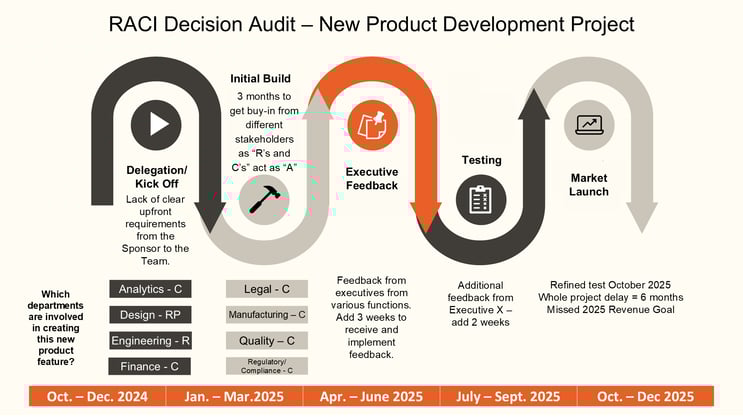
- Compare the exemplary projects and the under-performing projects.
When you do this for both “successful” and “stuck” projects, you’ll uncover patterns. Less successful projects usually have multiple A’s for each decision, which leads to time-consuming escalation paths. They often have heavy “C” lists of stakeholders who all believe they have full “sign off” authority reflecting consensus culture. For each mapped decision, ask four questions:
(1) Was there exactly one “A” for this decision, clearly understood as the person or team who decides or vetoes?
(2) Was the “A” located as close as possible to the work and the context, rather than sitting far up in the hierarchy?
(3) Were the “C” roles adding value, or were they acting like additional approvers and bottlenecks?
(4) Where could you have combined “A/R” in the same role so the person or team doing the work also owns the decision and outcome?
- Then, use what you’ve learned to strengthen your decision culture.
Use your insights to sketch a future‑state decision culture for each upcoming project that concentrates A’s, trims the fat of unnecessary consultation, and keeps executives in genuine sponsorship roles rather than day‑to‑day approvals. - Hardwire the changes you want to make.
Turn your redesigned decision-making practices into templates for recurring decisions—strategy choices, funding approvals, cross‑functional handoffs, and customer‑impacting changes—and build them into your governance routines, project kickoffs, and leadership expectations. - Measure your time-to-decision performance for all projects going forward.
Add deadlines to all the decisions in your project plans and then monitor performance against those deadlines. You want to develop performance metrics for your decision-making, which may vary based on the type of decision to be made.-
Strategic decisions: 30-90 days
-
Tactical decisions: 7-30 days
-
Operational decisions: 1-7 days
-

As we move closer every day to integrating AI technologies into business, there is a transformative opportunity to automate routine decisions, predict and resolve bottlenecks, and standardize practices. This is worth doing. Research by McKinsey & Company indicates that organizations with optimized decision-making processes achieve 20% higher revenue growth and 15% better profitability compared to their peers.