
 The gas-to-liquid company was a joint venture in the Middle East, bringing together Brits, Scots, Arabs, and South Africans. In some ways, learning to work together required learning to speak a common language – the place seemed like a cultural Tower of Babel.
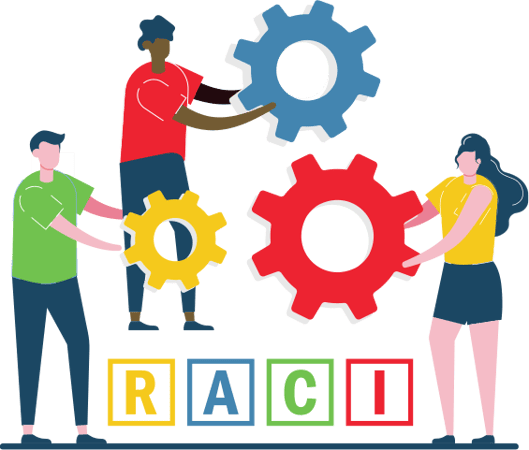
The Chief Quality Officer launched a project to map all of the plant’s process workflows to ensure that everyone was on board with WHAT the work involved. After two years and 2,000 processes, the work won an international quality award. But at no time did anyone think about WHO would be involved in producing these workflows, and what their role would be. The flowcharts looked great, but they didn’t translate to a change in behavior. The chaos continued, so they called RACI Solutions. Could we convert all 2,000 processes into RACI charts, and then combine them in a way that made everyone clear about their roles? Could we teach them to use RACI as a language to help strengthen accountability? We could and we did.
Roles AND Goals
In Tamara Erickson’s wonderful HBR article, “The Biggest Mistake You (Probably) Make with Teams” [1] she uses a metaphor that nearly everyone can understand. Lately we have been watching “The Pitt” (about the emergency department at the fictional Pittsburgh Trauma Medical Center) at home which underscores her message:
 “Before the next ambulance arrives, a team of doctors and nurses working in a hospital emergency room have no idea of the nature of the task ahead. Will the patient require surgery, heart resuscitation, medications? The condition of the next patient is unknown; the tasks that will be required of the team, ambiguous. But at no time while the team waits, do they negotiate roles …. Each role is clear. As a result, when the patient arrives, the team is able to move quickly into action.” [2]
As change accelerates around us, this insight that role clarity = speed is powerful and underappreciated.
5 Must Do’s to Create a High Performing XFN Team
In our experience, cross functional teams pay a great deal of attention to their charters and workplans – the WHAT they are tasked with doing – but hardly any time focusing on the role of individuals on the team, or the decision-making authority the team, or its members, will have. This is usually a costly oversight.
1. Recruit team members with clear role expectations.
Be very clear if you are asking for someone to join the team to contribute their expertise, in which case the emphasis is on attending critical meetings and offering their counsel. (This is the C or “Consult” role.) Or if you are recruiting someone to do actual work, define this as helping to produce some kind of deliverable for the team. (This is the R or “Responsible” role.) They might do a resource plan for what will be needed from their area, or write up a set of recommendations, or draft a presentation to senior leadership. These two roles are very different and they are often confused. When expectations aren’t set clearly at the beginning, we often find that members of the team feel resentful and like they are doing more than their share of the work. “Picking up the slack” for absent team members is an indicator that expectations weren’t clearly set at the beginning.
2. Create clear deadlines for the team – for activities AND decisions.
In RACI 2.0, we add one element that the original RACI is missing – deadlines for each activity and for each decision along the way. The team sponsor usually sets an overarching deadline for the team’s work, in negotiation with the team leader. The Big R – usually the team leader – will then be able to hold team members accountable for completing their tasks on time. Click HERE to download a fillable RACI template with a column for deadlines.
Adding deadlines allows you to create a project timeline, or a “project roadmap”, defined as “a high-level visual tool outlining goals, milestones, deliverables, and timelines for project alignment.”[3]
3. Set formal check-in meetings with the team’s sponsor(s).
Scheduling formal check in points for the team with its sponsor (s) – all along the way – helps to reinforce the deadlines. This gives them “teeth”. When a cross functional team knows it needs to reach a certain milestone and present its work to senior leadership, the team will come through. Deadlines and check-ins communicate that the work is important and worthy of attention. It raises the stakes.
4. Clarify the Team’s Authority
 Cross functional teams often get stuck because they are unclear about where and how decisions will be made (decision rights). We recently worked with new product development teams at a medical device company. The teams believed they had the “A” (decision making authority) to determine the FDA strategy for their product. The executive in charge of Quality believed that the final decision belonged to her. The Quality representative on the team was hearing mixed messages from his boss and from the team and it led to conflict. Decisions would be made, then unmade, and then finally escalated to the senior team – and time was wasted.
What decisions can the team make on its own? This is one question that needs to be answered by the senior leadership team. If one function is empowered, but three others are not, decisions will continue to be made outside of the XFN team. The leaders at the medical device company needed to align on what the teams’ authority should be – and then make it clear to the team leaders.
5. Clarify Team Member Authority
When someone joins a cross functional team, it is usually the case that they are there to represent their function. Representation is work – but often there is no thought given at all as to HOW they are doing the work of representation.
- Are they there to just collect information and bring it back to “home base”?
- Are they there to educate the team about their function – what is important, what is costly, what kind of expertise they represent, how their area needs to be consulted before final decisions are made?
- Can they make commitments on behalf of their function? (For example, can someone from IT guarantee the team’s issues will take priority, can someone from Finance commit budget resources?) If not, and they need to run “shuttle diplomacy” between the team and their function leader, it’s best to know that from the beginning and build time into the process for those negotiations.
Formula One - Another good example of world-class role clarity
This video illustrates the difference between a Formula One pit stop in 1963, which took 67 interminable seconds, and one in 2013, which took only 6 seconds. In 2025, the median pit stop time was between 2.3 and 2.7 seconds (McLaren holds the record at 1.8 seconds) [4] . How do Formula One pit crews accomplish so much in so little time?
First, everyone knows exactly what their role and position are – just like the trauma team in the Emergency Department. Everyone is crystal clear about what their deliverable is – in the video you can see that some team members take off the old tires, as others stand ready to mount the new ones.
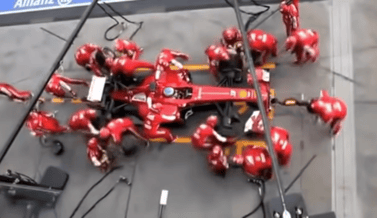 These crews train their individual skills – how can I improve my skills? How do I improve my agility? My speed? Their performance is monitored in real time with a giant dashboard that shows them the seconds passing by. THEY ALSO TRAIN THEIR COORDINATION, by training together as a team. Pit crews train with older cars at their factories, and with the real race car at the track. This kind of “practice” is a luxury that business teams rarely enjoy even though skillful coordination will make or break strategy execution.
What we CAN do is set up our teams with role clarity, and be conscious of the dynamics as well as the substance of their work.
We advise cross functional teams to pause to do “look backs” after each project to critique their coordination and draw lessons for how it can be improved going forward.
- Erickson, T. (2012, April 5). The biggest mistake you (probably) make with teams. Harvard Business Review. https://hbr.org/2012/04/the-biggest-mistake-you-probab
- Erickson, T. (2012, April 5). The biggest mistake you (probably) make with teams. Harvard Business Review. https://hbr.org/2012/04/the-biggest-mistake-you-probab
- Atlassian. (n.d.). Project roadmap. https://www.atlassian.com/agile/project-management/project-roadmap
- Horton, P. (2025, April 11). In Formula 1, a 2-second pit stop is a vital dance. The New York Times. https://www.nytimes.com/2025/04/11/sports/f1-pit-stop-racing.html