

"Creativity is intelligence having fun.” – Albert Einstein
This is the third in a series of blogs on Empowerment, introducing the SIT Empowerment Model (Skill, Innovation, Trust). For the blog about skill, see Ready or Not: RACI and Empowerment, and for the blog about Trust, see RACI and Empowerment: Trust is the Hidden Variable.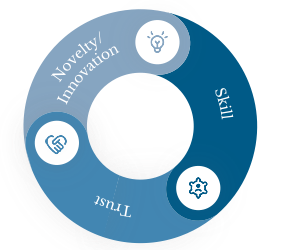
The final ingredient in the Empowerment recipe is Novelty or Innovation.
Why Innovation?
Because it is much harder to delegate an assignment or empower someone to create when even you don’t know what the final product could be. In other words, when you are innovating, there is a lot of uncertainty, and a lot of iteration. Misunderstandings can abound.
A decade or so ago, when I was a much younger consultant, I asked an analyst on our team to research a topic and bring me back references for a proposal I was writing. Days went by, the proposal went off without the reference, and I was annoyed with the analyst. Finally, the next day, he came to my office ready to report on his research – which had taken three days of his time because there were thousands of articles on the topic.
I was horrified, because when I asked him for help, I imagined it would take about an hour. It was a Master Class in delegation failure.
- I wasn’t specific enough.
- I didn’t explain the context – a proposal that needed to go out in 36 hours.
- I didn’t create a deadline or a check-in.
- I didn’t share my assumption that this would only take an hour of his time.
- And I didn’t really know much about what I was asking – it was exploratory.

Why Innovation Too Often Means Rework
Building something novel means operating in the fog. Unlike routine projects — where requirements are known, outputs are predictable, and we know what "done" looks like — innovation projects are defined by what researchers call "technological feasibility uncertainty, commercial value uncertainty, and competitive uncertainty." That fog isn't a sign of poor planning. It's inherent to the work. But uncertainty without a clear compass creates a predictable (and expensive) side effect: teams move, then course correct, then move again. The core problem isn't that innovation is messy. It's that organizations treat it like it isn't.
The Leadership Vacuum at the Start
Most innovation rework doesn't happen at the end of a project. It happens because of what didn't happen at the beginning. When leadership fails to define the problem clearly, set directional guardrails, or communicate strategic intent, teams fill that void — with assumptions. Those assumptions then get baked into weeks or months of work. McKinsey research reinforces this, noting that "wrong decisions" at the idea selection and prioritization stage — often driven by "lack of corporate and innovation strategy or insufficient information" — are a leading cause of innovation failure. Leadership presence at the front end isn't micromanagement. It's the cheapest investment a company can make.
Beware The Feedback Gap - It Multiplies the Cost
There's a second, quieter culprit: slow feedback from leadership once work is underway. When teams can't get timely input — on direction, feasibility, strategic fit — they don't stop. They keep building. And when leadership finally weighs in, their work gets redirected. McKinsey found that 85% of executives agree that fear and uncertainty hold back innovation "often or always" in their organizations — and that a lack of feedback cycles is central to that problem.
Short feedback loops don't slow innovation down. They're what keep it from going sideways — and having to be done twice.
Consider a new product development team. It’s cross-functional by design. It is under intense pressure to create something innovative. The leadership wants to “empower” this team to create something awesome, so they stand back to give them space and (not enough) time.
What can go wrong in this scenario? If the team has too little initial guidance, if roles and authority are unclear, and if check-ins are infrequent, then at some point leadership will “swoop” in and send the message that the team has gotten off course. Nothing is more discouraging or disempowering, so the original instinct to “empower” this team backfires.

Four Remedies to Avoid Rework
Leaders can avoid the pain of rework, by designing four elements into their company’s innovation practice.
- Create clear guidelines for innovation teams. Share the context and the constraints with the team when it is chartered. Create a list of things “not to do” along with the team’s aspirational goal – define what is off limits. Clarify the team’s role – does it have the ultimate A for Accountability/approval? Or is it responsible for bringing back a recommendation to another group that has decision-making power?
- Schedule routine check ins from the beginning. The more creative and novel the work, the more frequent the check ins need to be, to make sure the team and company leaders stay aligned.
- Don’t forget to set “time budgets” throughout the project. Always specify how long you believe each element of the project will (likely) take. Half the time you will be wrong and will need to be educated about what is more realistic. The other half the time you will be right – and set the team up for success, by being clear about the level of effort you expect.
- Set “milestones” instead of deadlines. When the work is novel, setting deadlines can be fictional. What if instead I had set a milestone for my young analyst instead? “Work on this for 2 hours and then come back to me with what you are learning” is an example of a milestone, defined as a “stage or achievement in a journey, process or project.”
With these four practices in place, you can genuinely empower innovation in your organization and avoid the pain of rework.