
 A quick review of recent studies turns up the same discouraging statistics about meetings. Though leaders rarely set out to waste their team’s time, research shows that the problem of ineffective meetings has gotten worse since the transition to remote work. [1] A study conducted by Harvard Business Review finds that about 70% of meetings keep employees from doing the real work they are accountable for completing. During the pandemic, average meeting length dropped by roughly 20%, but the number of meetings per person rose by 13.5%, fragmenting attention and leaving less uninterrupted time for execution. For organizations that rely on cross‑functional collaboration (horizontal work), that fragmentation becomes more than an annoyance; it becomes a structural drag on performance. [2]
HBR’s work on meeting overload shows that newly promoted managers, in particular, respond to uncertainty by scheduling almost a third more meetings than experienced peers, trying to manage risk through conversation instead of through crisp decision rights.
And ineffective meetings are costly. Steven Rogelberg’s recent study for Otter.ai found that employees spend about 18 hours per week in meetings and judge nearly one‑third of that time to be unnecessary. When you translate those hours into salary and benefits, that’s roughly $25,000 per employee per year in wasted investment. At the enterprise level, a 5,000‑person company is leaving an estimated $100 million on the table annually by keeping people in meetings where their presence is not critical. For smaller firms with 100 employees, the waste still totals about $2.5 million a year—real money that could have been invested in customers, innovation, or talent. [3]
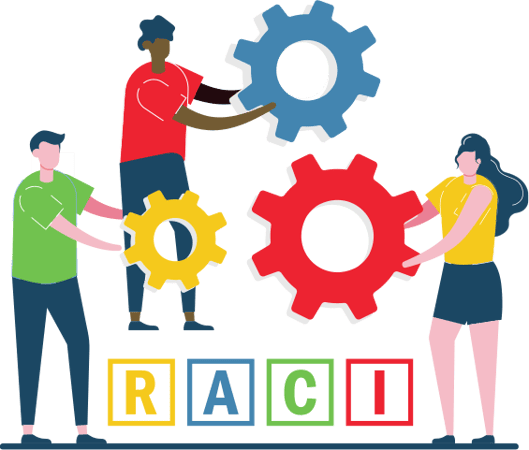
If we look at the problem through a RACI 2.0 lens, there are 4 specific ways to improve meetings:
1. Clarify the team’s authority..jpg?width=384&height=247&name=shutterstock_2147433225%20(1).jpg)
What decisions are they asked to make? Cross functional teams are often unclear where the final decision making lies. Is it with the team leader? Is it the whole team? Is it someone at a higher level in the org chart? While building consensus is nice, it’s also very time consuming. Remember that if the team essentially has a “C” role (to consult) or even an “R” (Responsible) role, it may not be necessary to come to consensus. The team can present “as much agreement as possible” and then also provide several options for the final decision-maker. See “Better Accountability for Cross Functional Teams”.
2. Clarify each team member’s accountability.
Some members of the team are there to produce work, the “R” role. Others may be there to offer their expertise and advice, the “C” role. We often recommend that clients keep a small working group at the core of a cross functional project and then expand the meeting periodically to include all the “C” stakeholders. They can join at the beginning to shape the group’s thinking. Then they can return periodically to react to the group’s work. Again, they do not all have to agree, which is the beauty of the “C” role. See “Empower Your Meetings: RACI for Teams”.
 3. Seek clear parameters from leadership from the beginning.
Nothing is more discouraging for a team than working on something for months, only to have senior leadership say – “Oh, that’s not what we wanted!” Too often, leaders aspire to create empowerment – and send people off with too little information. Ask questions like this to understand the guard rails:
- Which stakeholders are most important to satisfy?
- What are the financial constraints?
- Is the final deadline flexible?
- How often would you like to check in on the team’s progress?
 4. Track follow up actions with discipline.
Meetings proliferate as stakeholders seek informal alignment, revisit old decisions, or delay committing to a path. The Chartered Institute of Personnel and Development (CIPD) created an evidence review on productive meetings. [4] Their report highlights that clear procedures—agenda, decision focus, and role clarity—explain a large share of the variance in meeting effectiveness. Simple shifts such as moving status updates to asynchronous channels, defining in advance whether a session is for input or for decision, and explicitly naming who is Responsible, who Authorizes, who must be Consulted, and who is merely Informed turn meetings from vague conversations into focused commitments.
When leaders treat each meeting as a governance choice rather than a default, they honor people’s time, reduce that $25,000 per‑person waste, and create the conditions for faster (quality) decisions.
Download a Meeting Agenda template with explicit RACI roles here.
For organizations serious about improving speed‑to‑decision, the meeting calendar is a powerful diagnostic. If you see recurring sessions with no clear RACI, large invite lists “just in case,” or conversations that end with “we’ll circle back,” you are looking at hidden costs. By redesigning those meetings around explicit roles and clear next steps, you not only recover hours and dollars—you also send a cultural signal: time is a strategic asset, and participation is tied to purpose. That is the discipline behind effective RACI 2.0 practice, and it is also the foundation of meetings that people actually want to attend.

[1] Laker, B., Pereira, V., Malik, A., & Soga, L. (2022, March 9). Dear manager, you're holding too many meetings. Harvard Business Review. https://hbr.org/2022/03/dear-manager-youre-holding-too-many-meetings
[2] Ibid.
[3] Worklytics. (2025, November 5). The hidden cost of ineffective meetings. https://www.worklytics.co/blog/the-hidden-cost-of-ineffective-meetings
[4] Young, J. and Gifford, J. (2023) Productive meetings: An evidence review. Practice summary and recommendations. London: Chartered Institute of Personnel and Development. This report and the accompanying practice summary are available at https://www.cipd.org/globalassets/media/knowledge/knowledge-hub/evidence-reviews/2023-pdfs/8385-productive-meetings-practice-summary-may23.pdf